Governance
Rules, actually followed.
Code rules enforcement, in every repository.
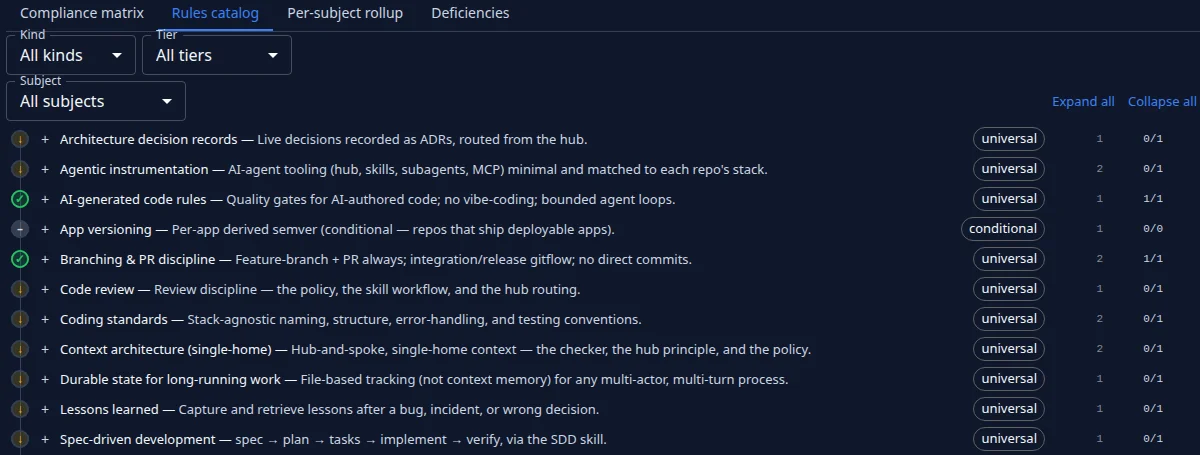
Branching, code review, coding standards, decision records, spec-driven development: each is a rule, in a ready-made pack or in your own fork of one. Code rules enforcement carries the rules and the files behind them into every governed repository, and a repository that drifts from them gets a reviewed change that brings it back.
- Ready-made packs of rules, or your own
- Carried into every repository as a reviewed change
- Drift comes back as a change to that repository
Branch protection. No sweet-talking.
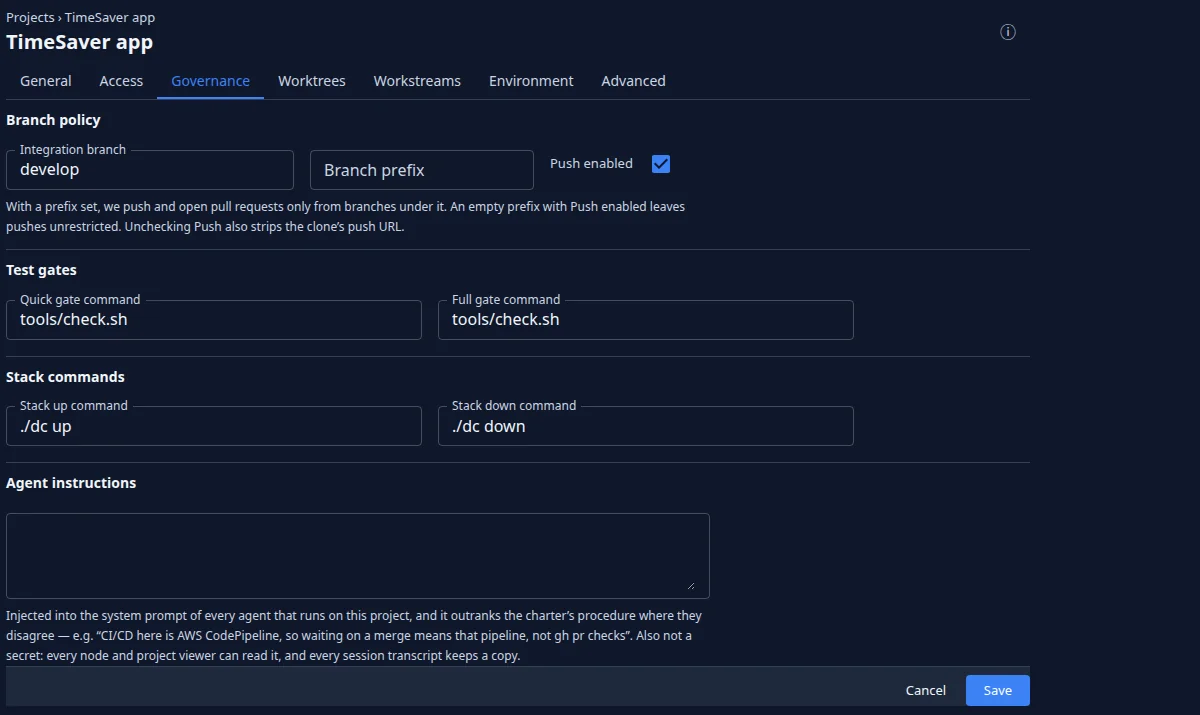
Agents open pull requests into the integration branch you name, on GitHub, GitLab, Bitbucket or Azure DevOps. A guard on the machine refuses any push to it or to main, a branch prefix confines the fleet, and switching push off removes the push URL altogether.
- Integration branch, branch prefix and push switch, per project
- Refused at push time, on the machine itself
- Gate commands and standing instructions, per project
Every rule, every repository, one grid.
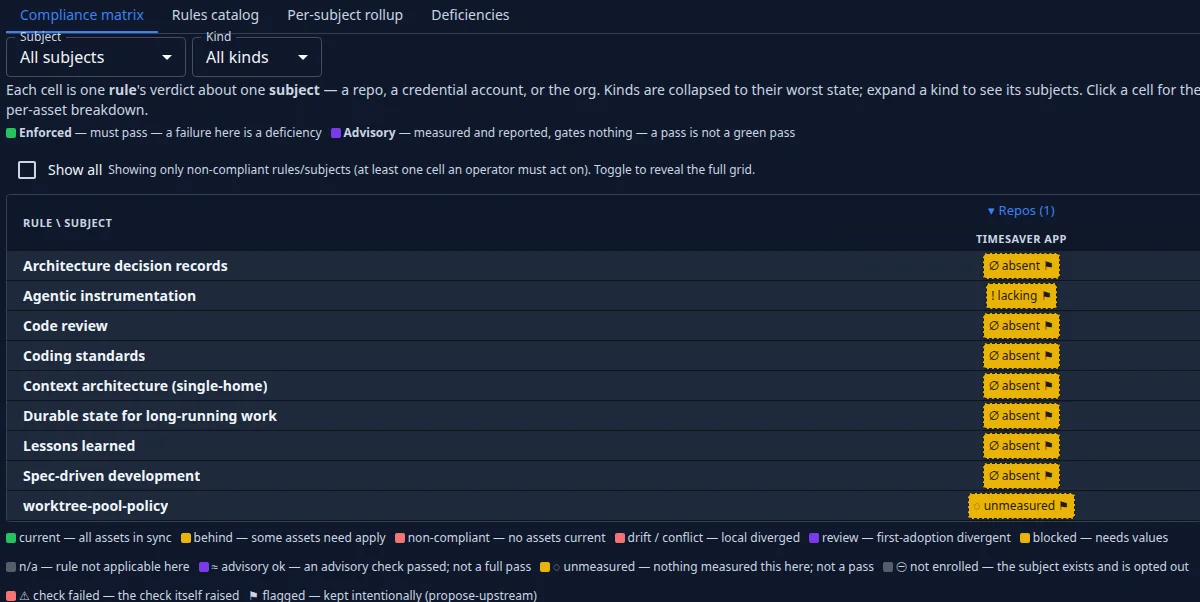
Compliance reporting in one grid: every rule against every repository of every project, pass or fail, waived or out of scope, and the level each one reaches. Stop a scan while it runs, or rescan one row whose scan ended in an error; a waiver carries an owner, an expiry and a compensating control. Start a campaign, and every repository failing the same rules gets its own fix.
- Pass or fail, per rule and repository
- Stop a scan, or rescan the one row that failed
- One campaign, a fix in every repository
Auto code-review. No rubber stamp.
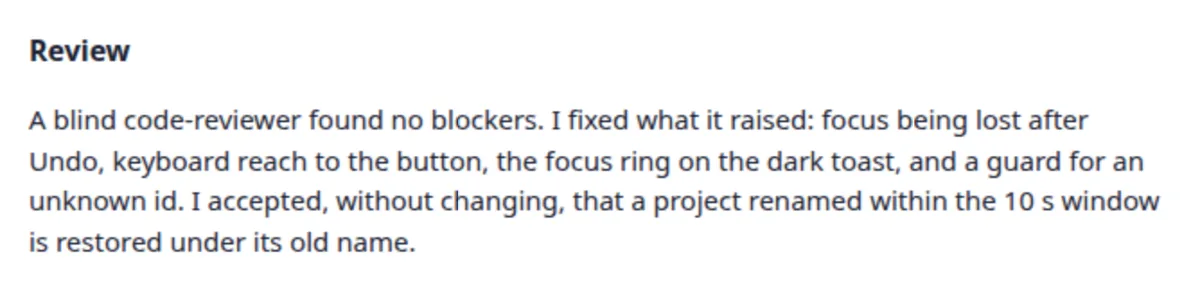
Every change gets an auto code-review: independent reviewers read the change and the spec — its code, its security and each acceptance item. Blockers are fixed before anything ships. A change to authentication, credentials, migrations or personal data waits for a person — or, in Full auto, clears a security review of its own before it merges.
- Code review, security review, verification — each its own pass
- Blockers fixed before it ships
- Security-sensitive changes: a person, or a security pass of their own
Policy enforcement, as the agent writes., Beta
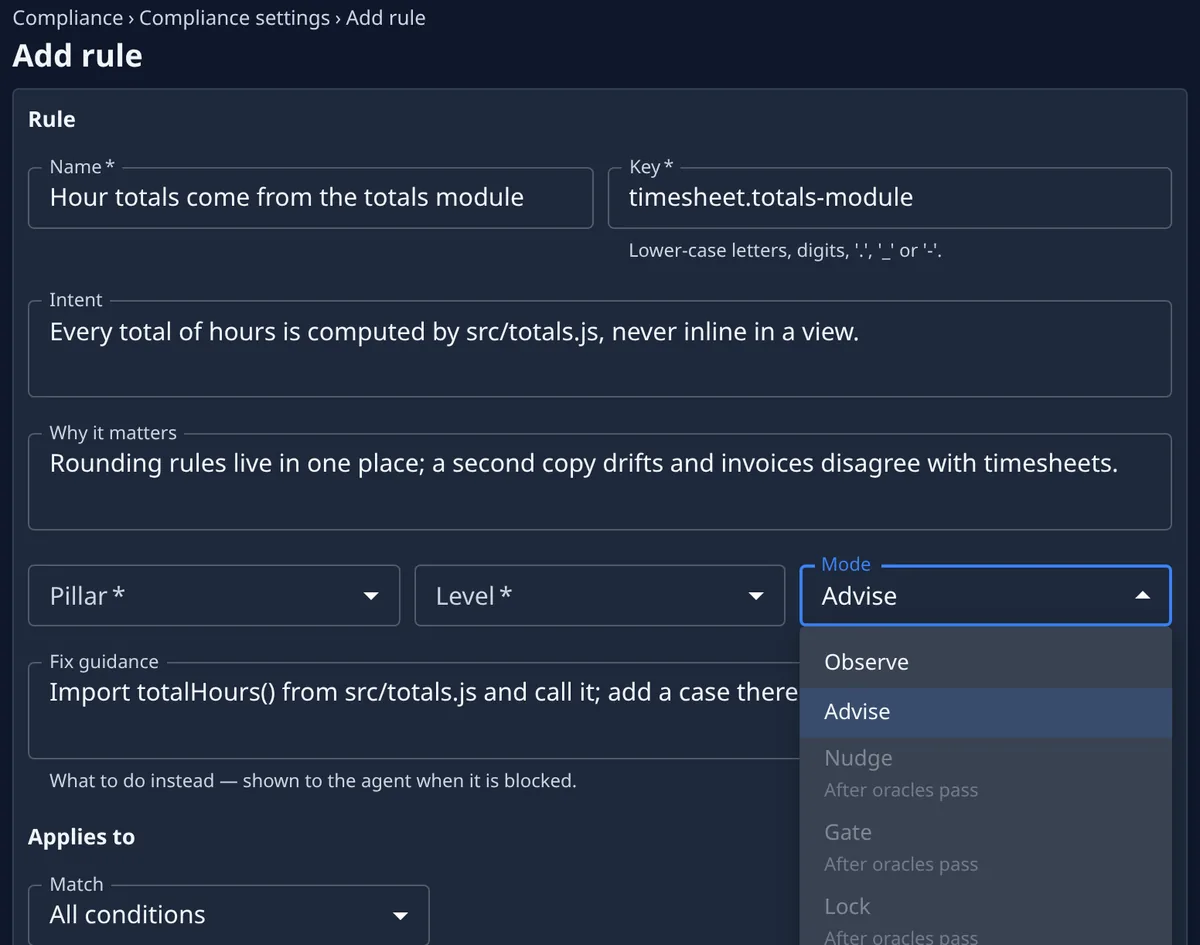
Policy enforcement starts where the code is written. A rule starts by observing or advising. Once its checks pass, put it in gate or lock mode, and the Architectural Guard checks every file an agent writes against it, with a second check at commit and push. A blocked agent is told what to do instead, one stuck on a rule offers a one-click waiver for the project, and Guard activity lists every change it stopped.
- Every write checked, as it is written
- A backstop at commit and push
- Every block listed, every waiver revocable
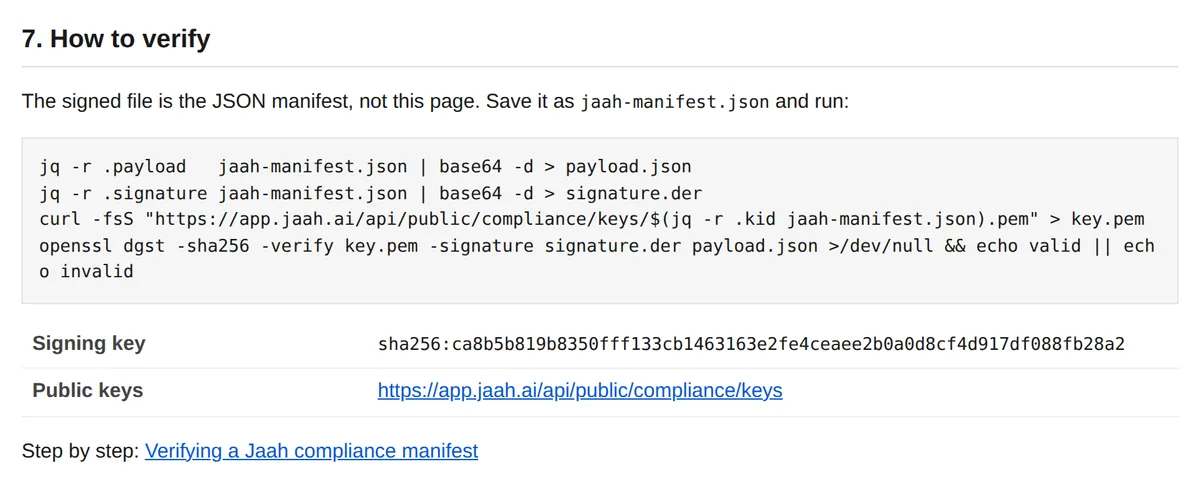
A signed record anyone can check.
When a task is done, its compliance manifest is sealed, a compliance report for that one change: who asked, every answer a person gave, the sessions that ran, the commits it made and the checks it passed, then signed. Download it as a page or as JSON, and anyone can verify it in the console, or offline with openssl and the published key.
- Sealed when the task is done
- Signed, with the public key published
- Verified without an account, even offline
What a governed repository carries
The same small set of files, in every repository.
Every governed repository carries the same small set of files, so an agent finds the rules in the same place everywhere.
- A hub file at the root: the hard rules and a router to everything else
- The policies the rules are made of — branching, code review, coding standards, decision records
- The check script the agents run, and the hooks that run it before every commit and push
- The skills an agent loads for the stack it is working in
Rules, for something that knows better.
Start free, then pick the plan that fits the repositories you would govern first, and the standards they have to keep.