Autonomous DevOps
From an empty cloud account to a release someone is watching.
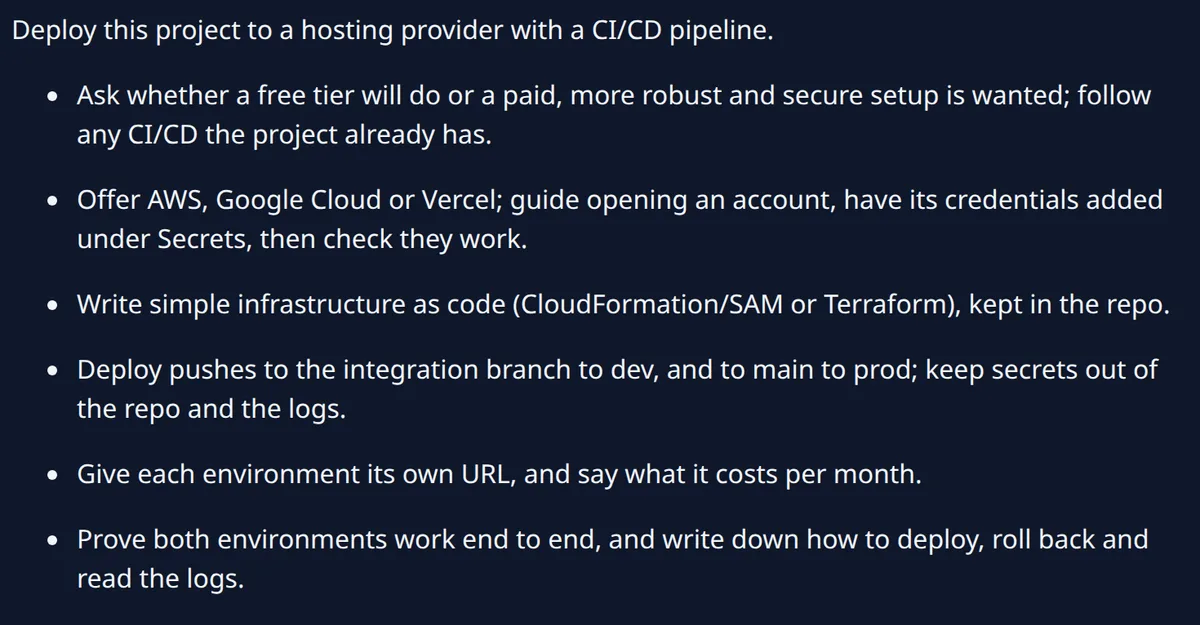
Your cloud, set up and deployed by an agent.
Hand over the deploy as a task. An agent provisions your cloud on AWS, Google Cloud or Vercel as infrastructure as code in your repository, and builds the pipeline that tests and deploys every change. It runs your database migrations, gives each environment its own address, watches it and rolls back a release that goes wrong. Your team gets the steps to deploy, roll back and read the logs in writing.
- Infrastructure as code in your repository
- An address for every environment
- A rollback written down, and run when needed
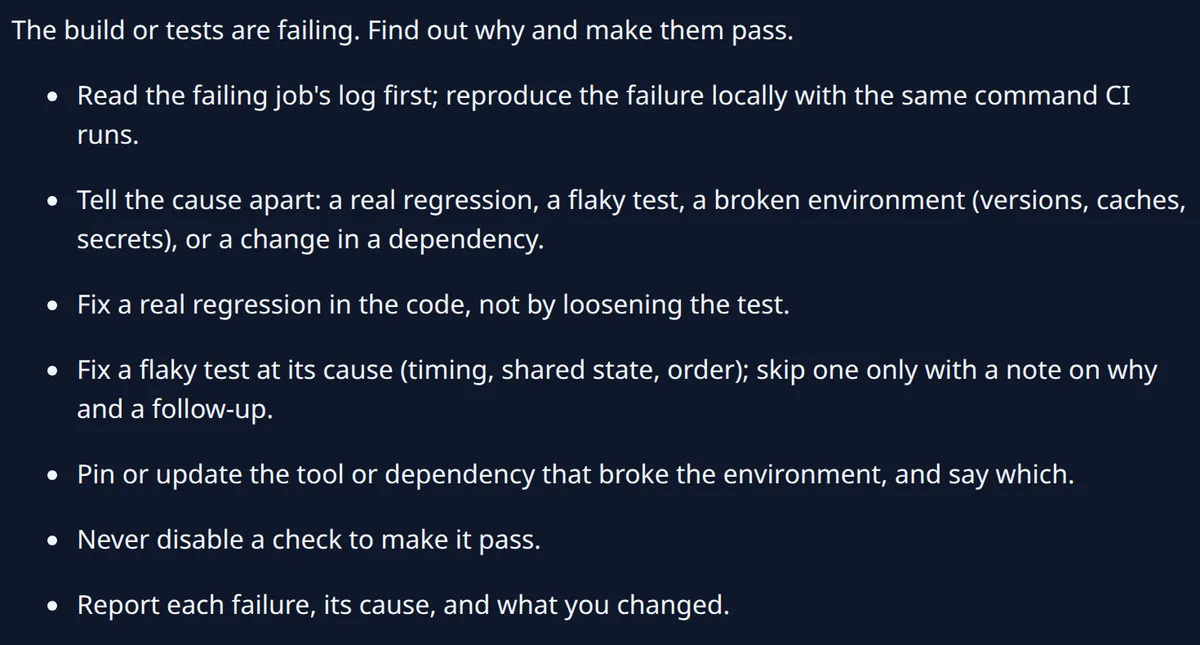
A broken build, fixed at the cause.
Agents build your pipelines and keep them running. When a build or its tests fail, an agent reads the failing job’s log and reproduces the failure with the command your pipeline runs. It tells a real regression from a flaky test or a broken environment, then fixes the cause with every check left switched on. The report names each failure, its cause and what changed.
- The failing log, read first
- The cause fixed, every check left on
- Each failure, its cause and the change
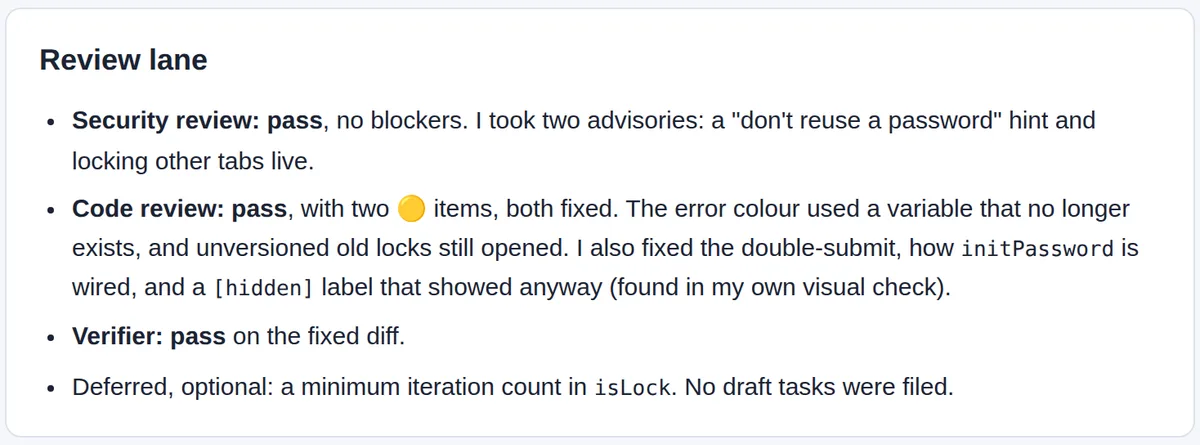
Risky changes wait for you, or for a security review.
A change that migrates your database, touches sign-in, handles credentials or reaches personal data waits for your approval. Run fully unattended, it goes through a security review of its own, beside the code review, before it merges. Each blocker the reviewer raises is fixed, and the report records what each review found and what was done about it.
- Migrations, sign-in, credentials, personal data
- Your approval, or a separate security review
- Every blocker fixed before it merges
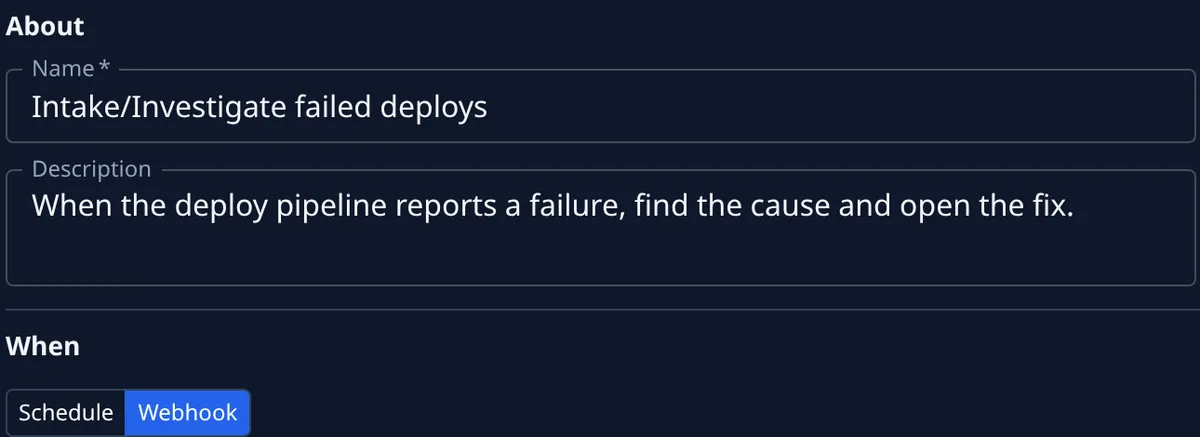
An alert that files its own fix.
Point your monitoring or your deploy pipeline at an automation’s webhook and an alert becomes a task. A failed deploy or a production alarm reaches an agent with whatever the alert carries, and the agent finds the cause and hands back the fix. Each automation has its own limits on how many run at once, how often and how much it spends, and it pauses itself after repeated failures.
- A secured webhook per automation
- An alert in, a task out
- Limits, a budget and an automatic pause
A browser, a terminal and an IDE, on a machine of its own.
Agents work in a browser, a terminal and an IDE, and check their work by looking at it: a changed page is rendered on the running app, captured at each screen size and checked before it comes back to you. They run on an isolated machine, in their own copy of the code, with a guard on what they may push. They reach your accounts only through credentials you grant, handed over per call. Turn on MicroVM and each task gets a virtual machine of its own, its network held to an allowlist.
- A browser, a terminal and an IDE
- Every result looked at, with screenshots
- Your accounts, through credentials you grant
Access
What agents may touch.
An agent gets exactly the access you hand it, and every use of that access is recorded.
- Credentials you grant, encrypted and handed over per call
- Sensitive changes wait for your approval, or a separate security review
- With MicroVM on, a network held to the names you allow
- A guard on what an agent may push, and to which branch
- Every action in the audit trail
Your next release, handed over.
Start free and hand the next deploy to an agent: your cloud, your pipeline, and your approval on the sensitive part.